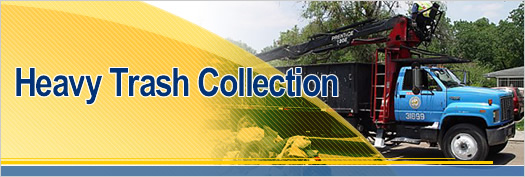
Heavy Trash Crane TruckOnce a month, residents can dispose of large bulky items such as furniture and appliances through the heavy trash pickup service. Heavy trash includes white goods such as refrigerators, washing machines and dishwashers (freon must be taken out of appliances), old furniture, mattresses and wood waste such as large tree branches. A maximum of four cubic yards of building material (not including brick, plaster or concrete) generated by the resident in connection with the maintenance of the resident's property will be collected by heavy trash.

Residents are encouraged to separate the recyclable wood waste from the non-recyclable heavy trash. On the day of heavy trash pick-up, citizens should place materials adjacent to the front curb in a location easily accessible to the collection vehicle. Heavy trash should be placed for collection between the hours of 6 p.m. the Friday before, and 7 a.m. on the scheduled collection day.

This service is undergoing change brought about by technological advances. A heavy trash crew equipment configuration, consisting of three open-bed trucks, is being replaced by two semi tractor-trailers, which will double the capacity of each crew. New grapple trucks are able to separate some scrap metal from heavy trash. This recyclable scrap metal is sold, with the revenue going to the general fund.

Placement Instructions:

  • Heavy trash should be placed adjacent to the front curb in a location easily accessible to the collection vehicle between the hours of 6:00 p.m. the Friday before, and 7:00 am. on the scheduled collection day.
  • Heavy trash material should not be stacked under low overhead electrical wires or other cabling, signs, or mailboxes; next to fences or posts; or on top of water meters, gas meters, fire hydrants, or other exposed utility components.
  • Materials should not be placed in the street, on the sidewalk, or other right-of-way, or in any manner which would interfere with pedestrian or vehicular traffic.
  • Heavy trash collection is limited to residential units and vacant residential lots only if the waste generated is in connection with the maintenance of the property.
  • Styrofoam blocks or loose packing material should not be mixed with heavy trash piles.  Styrofoam does not decompose.  We encourage you to bring your styrofoam to a local company. Styrofoam in peanut shape is accepted by Mailbox, Etc.  They can be reached at 713.667.5116.  The last alternative is to to bag your styrofoam and put it out for your weekly garbage collection.

Restrictions:

  • No more than 8 cubic yards of heavy trash may be placed at the curb for collection.
  • A maximum of four cubic yards of building material (not to include roofing shingles, brick, plaster or concrete) generated by the resident in connection with the maintenance of the residential property may be collected by heavy trash crews.
  • Appliances containing refrigerant must have a tag attached to them certifying that a qualified technician has removed the refrigerant.
  • The Solid Waste Management Department is not allowed to collect any material that was generated by contractors who were retained by a resident to perform work on his or her residential property. It is the responsibility of the contractor to remove all debris that may arise from the contractor's activities. These contractor-related activities include, but are not limited to: trimming and removal of trees, remodeling, new construction and roofing.
  • If authorized items placed for collection are mixed with unauthorized items, department personnel shall not be obligated to sort the materials and may refuse the entire load.
  • Solid Waste Management Department collection services are not available to multi-residential structures of more than eight units.
  • The Solid Waste Management Department is not allowed to collect any material that was generated by contractors who were retained by a resident to perform work on his or her residential property. It is the responsibility of the contractor to remove all debris that may arise from the contractor's activities. These contractor-related activities include, but are not limited to: trimming and removal of trees, remodeling, new construction and roofing.