www.houstontx.gov > About Houston > Houston Facts and Figures

HOUSTON FACTS AND FIGURES

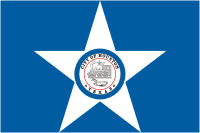
  • Houston FlagHouston is the fourth most populous city in the nation (trailing only New York, Los Angeles and Chicago), and is the largest in the southern U.S. and Texas.
  • The Houston-Galveston-Brazoria Consolidated Metropolitan Statistical Area (Houston CMSA) consists of eight counties: Brazoria, Chambers, Fort Bend, Galveston, Harris, Liberty, Montgomery and Waller.
  • Founded in 1836, the City of Houston has a 2006 estimated population of 2.14 million, according to the U.S. Census Bureau -- www.census.gov.
  • The metro area's population of 5.54 million in 2006 is 6th largest among U.S. metropolitan statistical areas, according to www.census.gov.
Estimated July 2006 Cities Population
New York
Los Angeles
Chicago
Houston
Phoenix
8,214,426
3,849,378
2,833,321
2,144,491
1,512,986
Estimated July 2006 Metro Area Population
New York, Northern New Jersey, Long Island
18,818,536
Los Angeles, Long Beach, Santa Ana
12,950,129
Chicago, Naperville, Joliet
9,505,748
Dallas, Fort Worth, Arlington
6,003,967
Philadelphia, Camden, Wilmington
5,826,742
Houston, Sugar Land, Baytown
5,539,949
Miami, Fort Lauderdale, Pompano Beach
5,463,857
  • The Houston CMSA covers 8,778 square miles, an area slightly smaller than Massachusetts but larger than New Jersey.
  • Houston's latitude is 29 degrees 45 minutes north and its longitude is 95 degrees 22 minutes west
  • Houston is 43 feet above sea level
  • The three-airport system served over 51 million passengers in 2006, including over seven million international travelers.
  • If Houston were an independent nation, it would rank as the world's 30th largest economy
  • The ACCRA Cost of Living Index shows that Houston's overall after-taxes living costs are 12 percent below the nationwide average, largely due to housing costs that are 26 percent below the average
  • Houstonians eat out more than residents of any other city. While here you can choose to indulge in one of the more than 11,000 restaurants ranging from award-winning and upscale to memorable deli shops.
  • Houston has a Theater District second only to New York City with its concentration of seats in one geographic area. Located downtown, the 17-block Theater District is home to eight performing arts organizations with more than 12,000 seats.
  • Houston has a unique museum district offering a range of museums, galleries, art and cultural institutions, including the City's major museums.
  • Houston has more than 500 cultural, visual and performing arts organizations, 90 of which are devoted to multicultural and minority arts and is one of five U.S. cities that offer year-round resident companies in all major performing arts
  • More than 90 languages are spoken throughout the Houston area.
  • Houston has professional teams representing football, baseball, mens and womens basketball, soccer, and AHL hockey.
  • Houston is home to the Houston Livestock Show and Rodeo. The largest rodeo in the world, it attracts more than 1.8 million visitors each year.
  • Houston has among the youngest populations in the nation. The city has the third-largest Hispanic and third-largest Mexican population in the United States.
  • Houston boasts more than 40 colleges, university and institutions - offering higher education options to suit all interests.
  • Houston is home to the Texas Medical Center, the largest medical center in the world, with a local economic impact of $10 billion. More than 52,000 people work within its facilities, which encompass 21 million square feet. Altogether 4.8 million patients visit them each year.
  • The Houston-Sugar Land-Baytown MSA's Gross Area Product (GAP) in 2006 was $325.5 billion, slightly larger than Austria's, Poland's or Saudi Arabia's Gross Domestic Product (GDP).
  • When comparing Houston's economy to a national economy, only 21 countries other than the United States have a gross domestic product exceeding Houston's regional gross area product.
  • Houston ranks second in employment growth rate and fourth in nominal employment growth among the 10 most populous metro areas in the U.S. In 2006, the Houston metropolitan area ranked first in Texas and third in the U.S. within the category of "Best Places for Business and Careers" by Forbes magazine.
  • Home to and more than 5,000 energy related firms, Houston is considered by many as the Energy Capital of the world.
  • Houston's economy has a broad industrial base in the energy, aeronautics, and technology industries: only New York City is home to more Fortune 500 headquarters.
  • The Port of Houston ranks first in the United States in international waterborne tonnage handled and second in total cargo tonnage handled. It is the tenth largest port in the world.