BARC Animal Shelter & Adoptions
Trap Neuter Return
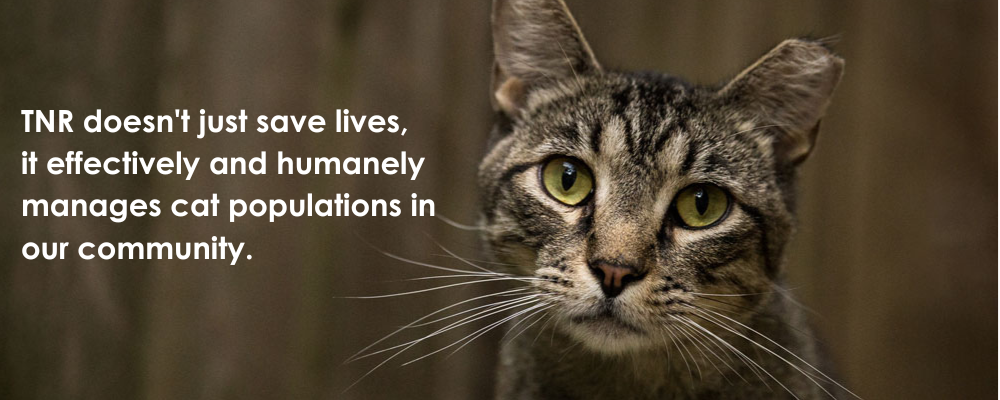
Trap Neuter Return, commonly abbreviated as TNR, is a humane and effective approach to manage outdoor cat populations. Through TNR community cats are humanely trapped, spayed or neutered and vaccinated. Cats that go through a TNR program have one of their ears painlessly removed to visually indicate they have been through a TNR program. Healthy cats are returned to the area they where trapped where they can continue to live and thrive, ending the cycle of producing new litters of kittens, thus reducing the population of cats brought to shelters. TNR programs continue to grow because they have been proven successful in improving cat health and reducing cat populations in a wide variety of environments.
BARC Animal Shelter & Adoptions proudly implemented a TNR program in (year) and through this program (number) of cats have been successfully spayed or neutered, vaccinated, and released back to their outdoor homes.
“Community cat” is an umbrella definition that includes any un-owned cat. These cats may be “feral” (un-socialized) or friendly, may have been born into the wild or may be lost or abandoned pet cats. Some community cats are routinely fed by one or more community members, while others survive without human intervention. Whatever a cat’s individual circumstances, the term “community cat” reflects the reality that for these cats, “home” is within the community rather than in an individual household.
A colony can range from 3–25 cats. Their may locations vary and there are many places a community cat may call "home". Community cat colonies can be in alleyways, parks, or neighborhoods. Members often consist of adult females, their young, and some adult males.
For a long time, "catch and kill" was a widely accepted method of managing community cat colonies. The cats were trapped and removed from their established colony to be euthanized. While this method causes an instant decrease in the overall colony numbers, it is not effective over time. Colonies subject to "catch and kill" typically end up increasing in number back to their original size as a result of what is known as the vacuum effect.
What is the vacuum effect? Community cat colonies, like other populations of animals in the wild, have a certain population size at which they are most stable. When the population size of a colony is drastically reduced in a short amount of time, the colony reacts by trying to return to the stable size, this is often called the vacuum effect. The remaining members of the colony increase mating activities in an effort to create more offspring and stabilize the colony population size. A reduction in size also opens the door for newcomers to the colony - other cats in the area may move in. Because of the vacuum effect, "catch and kill" has no lasting impact on the size of a community cat colony.
Once the community cats within a colony are spayed and neutered, not only will the population size gradually decrease, but the cats will also be healthier and coexist more peacefully within a neighborhood. Female cats, prevented from having any more litters, will be healthier. Male cats will gradually lose the urge to roam and fight, and will be less prone to injury. Behaviors associated with unaltered cats, such as yowling and marking territory with urine, will disappear.
It has been argued that cats should be collected from the community, impounded and euthanized in shelters to protect wildlife and public health. However, euthanizing or removing all community cats from an area may lead to an increased population of other non-native species with an even more detrimental effect.
There are many more cats in the community currently than BARC can take in over a short period of time. The TNR program will decrease the number of cats that could potentially harm birds and wildlife over time (refer to more information about the benefits of TNR above).
- Remove all potential food sources from the property: This would include pet food for the resident’s animals, meat scraps in compost, fallen fruit from trees, barbecue grills, excess bird food from birdfeeders and garbage. Garbage bags are very attractive to animals, so trash should be kept in containers with a secure lid, and put out in the morning of pick up to reduce the temptation for the animals.
- Limit availability of water: Limit access to water features, pools and ponds with fencing. Remove or repair sources of standing water.
- Remove or secure potential shelter areas: Secure access under houses, sheds, decks, porches and buildings with wire fencing. Open spaces beneath structures should be tightly screened with 1/4- or 1/3-inch galvanized hardware mesh. The bottom edge of the wire should be buried at least 6 inches deep, extended outward for 12 inches, so it forms an L shape, and then covered with soil, or heavy stones. Trees should be trimmed so that the branches that overhang roofs are at least 5 feet from the house. Bushes and shrubs need to be thinned and trimmed so that there is 18 inches of open space above the ground to limit the cover for animals to hide under.
- Other useful tactics to deter unwanted cats: Place chicken wire or plastic carpet runner, spikes up, under flower bed mulch to make scratching uncomfortable. Sprinkle coffee grounds or citrus peels or use citrus spray on gardens and shrubs. One very effective tool is a motion detection device combined with common water, available from various outlets. The cat breaks the beam of the device, and is immediately sprayed with a stream of water. This device works on raccoons, dogs, opossums and other animals, too.
Get Involved!
Are you feeding community cats in your community? Have you been trapping them and getting them spayed and neutered? If so, you might be interested in becoming a colony manager. By Trapping, Neutering, and Returning community cats of your neighborhood, colony managers make an impact on stopping the cycle of community cat overpopulation in your community and in the City of Houston.
The City of Houston promotes TNR for the management of our city's community cats, and citizens. Any citizen feeding community cats must be actively working towards getting all cats in the colony spayed and neutered (i.e. accomplishing the TNR of the colony), must be feeding in a way that does not attract raccoons or possums, and must have the permission of the property owner/manager to be feeding the cats if the colony location is not on either their own property or on city property. As long as citizens are in accordance with these requirements, they are encouraged to feed and care for the community cats within their colony and can submit an application to become an official colony manager.
According to Houston City Ordinance section 6-22, "It shall be unlawful for any person intentionally to cause, suffer, or permit the maintenance of an attractive environment for the assembly of a congregation of unconfined and unlicensed stray cats or dogs by the placement of dog food or cat food," however colony managers who follow city TNR guidelines are permitted to feed community cats "subject to a trap, neuter, and return program approved by the Director."
words meow meow moew
words meow meow moew
words meow meow moew
Visit Us
Location:
BARC Animal Shelter & Adoptions is located at 3300 Carr St. Houston TX, 77026, just a few minutes from downtown Houston off of the Eastex Freeway (59) and the Collingsworth/Calvacade/Kelly exit.
Hours:
Trap rentals and surgery appointments are by appointment only.Contact the TNR Office:
Phone: 832.395.9066
Email:
BARCtnr@houstontx.gov
Follow Us


